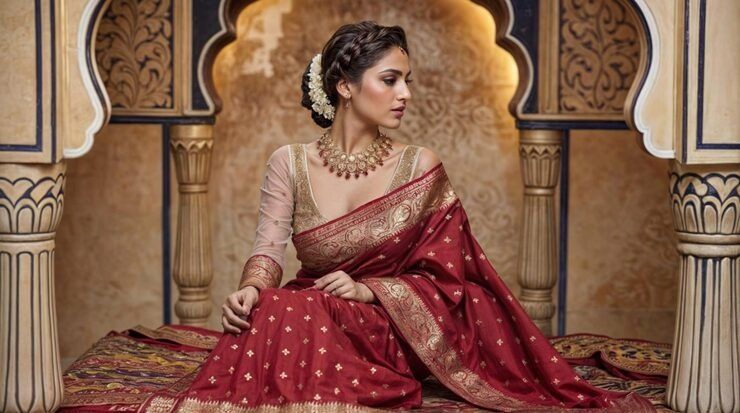
A designer bridal saree is a traditional Indian garment created specifically for weddings, combining cultural symbolism with detailed craftsmanship and contemporary design influences. The saree itself is one of the oldest forms of clothing in the Indian subcontinent, with historical references dating back several centuries. Bridal sarees emerged as a distinct category because weddings hold deep social, cultural, and ritual importance in Indian society.
Traditionally, bridal sarees were woven or embellished according to regional customs, religious practices, and family heritage. Over time, skilled artisans introduced intricate weaving techniques, hand embroidery, zari work, and distinctive motifs that conveyed prosperity, continuity, and celebration. Designer bridal sarees exist today to preserve these traditions while adapting to changing aesthetic preferences.
In modern contexts, designer bridal sarees balance heritage with innovation. They may incorporate traditional fabrics such as silk, cotton-silk blends, or handwoven textiles, while also reflecting evolving color palettes, patterns, and styling approaches. The purpose of a designer bridal saree is not only ceremonial but also symbolic, representing identity, tradition, and craftsmanship.
Importance: Why Designer Bridal Sarees Matter Today
Designer bridal sarees continue to hold significance in contemporary society because they connect cultural history with present-day expression. Weddings remain milestone events, and attire plays a central role in expressing values, traditions, and personal identity.
The importance of designer bridal sarees can be understood through several aspects:
-
Preservation of regional weaving and embroidery traditions
-
Representation of cultural and family heritage during weddings
-
Support for skilled craftsmanship and textile knowledge
-
Adaptation of traditional attire to modern bridal preferences
Designer bridal sarees affect multiple groups. Brides use them to express individuality while honoring tradition. Artisans and weavers rely on sustained interest in traditional textiles to keep techniques alive. Cultural historians and educators view bridal sarees as living examples of intangible cultural heritage.
By addressing the need for meaningful, culturally rooted wedding attire, designer bridal sarees help solve the challenge of balancing tradition with modern aesthetics in a changing social landscape.
Recent Updates: Trends and Developments in the Past Year
During 2024 and 2025, bridal fashion has shown a renewed focus on heritage-inspired design combined with subtle contemporary elements. Designer bridal sarees have increasingly featured region-specific textiles, highlighting weaving traditions from different parts of India.
One notable trend observed in late 2024 was the emphasis on handwoven fabrics and detailed craftsmanship. Bridal sarees featuring classic weaving styles, temple borders, and traditional motifs gained attention as part of a broader cultural revival. Designers have also explored softer color variations alongside classic reds and maroons, reflecting changing aesthetic preferences.
In early 2025, bridal fashion discussions highlighted customization and storytelling through attire. Designer bridal sarees began incorporating symbolic motifs, heirloom-inspired patterns, and regionally meaningful design elements. This approach reflects a growing interest in garments that carry personal and cultural narratives rather than purely decorative appeal.
Another development has been the increasing documentation and digital showcasing of bridal textiles, making information about regional saree traditions more accessible to wider audiences.
Laws and Policies: Cultural and Textile Regulations
Designer bridal sarees are influenced by cultural preservation policies and textile-related regulations rather than fashion-specific laws. In India, the protection and promotion of traditional textiles are supported through initiatives under the Ministry of Textiles. These initiatives aim to sustain handloom traditions, artisan livelihoods, and textile education.
Certain bridal saree styles are linked to Geographical Indication (GI) protection. The Geographical Indications Registry oversees GI status for region-specific textiles, helping preserve authenticity and traditional knowledge associated with specific saree types.
Cultural heritage programs at both national and state levels also influence how traditional bridal attire is documented and promoted. These policies help ensure that traditional weaving and embroidery techniques are recognized as part of India’s cultural heritage.
Tools and Resources: Learning About Bridal Sarees and Traditions
Several educational tools and resources help individuals learn about designer bridal sarees, textile traditions, and cultural significance. These resources are useful for students, researchers, and general readers interested in bridal fashion.
Helpful resources include:
-
Digital textile archives documenting regional saree traditions
-
Museum websites featuring historical bridal garments
-
Cultural research publications on Indian wedding attire
-
Educational platforms focused on handloom and embroidery techniques
-
Visual reference guides explaining saree draping and motifs
The table below provides an overview of common bridal saree styles and their traditional associations:
| Saree Style | Region | Key Characteristics |
|---|---|---|
| Kanjeevaram | Tamil Nadu | Heavy silk, temple borders |
| Banarasi | Uttar Pradesh | Zari work, floral motifs |
| Paithani | Maharashtra | Handwoven silk, peacock designs |
| Patola | Gujarat | Double ikat, geometric patterns |
| Baluchari | West Bengal | Storytelling motifs |
These resources support informed understanding of bridal sarees beyond surface-level aesthetics.
Frequently Asked Questions About Designer Bridal Sarees
What makes a saree a bridal saree?
A bridal saree is typically distinguished by its fabric quality, detailed craftsmanship, symbolic colors, and cultural relevance to wedding rituals.
Are bridal sarees the same across all regions in India?
No, bridal sarees vary widely by region, reflecting local weaving techniques, motifs, and cultural customs.
Why is red commonly used in bridal sarees?
Red is traditionally associated with prosperity, fertility, and auspicious beginnings in many Indian cultures.
How do designer bridal sarees differ from everyday sarees?
Designer bridal sarees usually involve more intricate weaving or embroidery and are created for ceremonial occasions rather than daily wear.
Can bridal sarees represent personal identity?
Yes, many bridal sarees incorporate elements that reflect family heritage, regional roots, or personal symbolism.
Conclusion: Bridal Sarees as Living Cultural Expressions
Designer bridal sarees represent more than ceremonial clothing. They are living expressions of tradition, craftsmanship, and cultural continuity. By blending historical techniques with evolving design sensibilities, these sarees remain relevant across generations.
Understanding the context, importance, and cultural framework of designer bridal sarees helps readers appreciate their role in weddings and heritage preservation. As bridal fashion continues to evolve, the designer bridal saree remains a meaningful symbol of identity, tradition, and artistic skill.