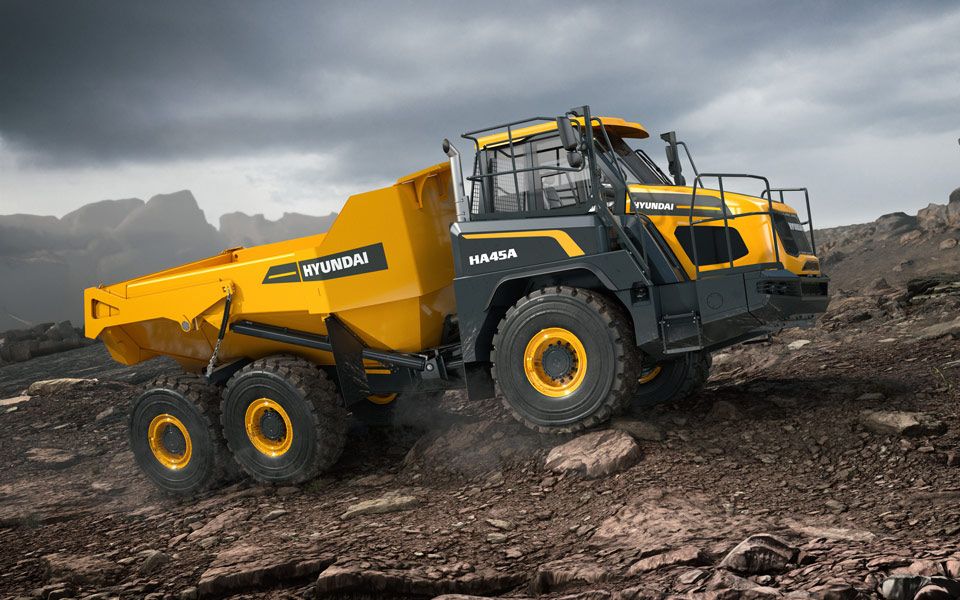
An articulated dump truck (ADT) is a heavy-duty vehicle with two main sections: a front “tractor” unit containing the engine and cab, and a rear “hauler” unit carrying the load, connected by a pivoting hinge. This articulation allows the two sections to move relative to each other, improving maneuverability on rough terrain, uneven ground, and in off-road settings.
This design emerged from the need for vehicles that could operate efficiently on rough, uneven, or soft ground where traditional rigid-frame dump trucks face limitations. Projects such as mining, quarrying, large-scale earth-moving, and infrastructure development often involve environments that lack paved surfaces, making maneuverability and stability essential. The articulated structure allows the vehicle to steer sharply, maintain traction, and balance weight even when operating on slopes or unstable terrain.
 Importance
Why articulated dump trucks matter today
Global development projects continue to expand, increasing the demand for equipment capable of handling large volumes of earth and rock. Articulated dump trucks play a major role in these operations due to their ability to perform consistently in harsh conditions. Their articulated joint allows them to navigate tight spaces, corners, and difficult ground without compromising stability.
These vehicles address several challenges found on modern job-sites:
-
They perform well on muddy, rocky, or soft surfaces.
-
They can move material efficiently in areas without developed roads.
-
They reduce downtime caused by difficult terrain.
-
They help maintain productivity in conditions where rigid-frame trucks cannot operate effectively.
Who benefits from articulated dump trucks
-
Construction and infrastructure contractors
-
Mining and quarry operations
-
Earth-moving and land-development companies
-
Safety engineers and regulatory authorities
-
Equipment designers and technical professionals
Problems they help solve
-
Transporting bulk materials where road conditions are poor
-
Working in environments requiring tight maneuvering
-
Maintaining stability on slopes and irregular ground
-
Reducing the need for site preparation or grading
-
Improving overall haul-cycle efficiency
Recent Updates
The articulated dump truck segment has seen notable changes in the past year, particularly in technology and sustainability. Key developments include:
-
Steady global market growth with continued demand from construction and mining sectors.
-
More compact models introduced for mid-sized or restricted job-sites, especially in the under-30-ton and 30–40-ton categories.
-
Integration of smart systems, including:
-
On-board weighing sensors
-
Telematics for fleet monitoring
-
Traction-control enhancements
-
Improved suspension systems
-
-
Automation and remote-operation research, such as systems using satellite-guided positioning and real-time monitoring to support semi-autonomous hauling.
-
Sustainability trends, including electric and hybrid concept haulers aimed at reducing emissions on large projects.
-
Increased interest in Asia-Pacific regions, where infrastructure expansion and resource extraction continue to drive ADT demand.
The industry is clearly shifting toward connected, cleaner, and more intelligent equipment, reflecting broader trends in the heavy-machinery sector.
Laws or Policies
Regulations governing articulated dump trucks vary by country, but most are centered around vehicle safety, axle-load limits, operating standards, and environmental compliance. In India, and many similar regions, articulated vehicles fall under specific technical guidelines and safety codes.
Key regulatory considerations include:
-
Vehicle classification and design standards
Articulated dump trucks are defined as multi-section vehicles joined by a hinge and classified under categories that specify structural requirements, including cab design, visibility, lighting, braking, articulation safety, and operator protection. -
Axle-load and gross-vehicle-weight rules
These determine how much an articulated truck is legally allowed to carry. Limits differ by region, but they generally specify maximum allowable weight across axles and total weight of the vehicle. -
Safety and operational requirements
Regulations often include:-
Mandatory safety features such as mirrors, lighting, warning alarms, and rollover protection
-
Stability requirements for the dump body
-
Procedures for safe articulation and movement of the hauler
-
Guidelines for training and operator certification
-
-
Environmental and emission standards
Diesel-powered ADTs must comply with engine-emission rules similar to other heavy vehicles. Newer models are increasingly designed to meet stricter nitrogen oxide and particulate-matter limits. -
Workplace guidelines
Mines, quarries, and construction sites may have additional site-specific rules governing vehicle access, slope operation, reversing, and material loading.
These rules help ensure safe operation, minimize environmental impact, and maintain structural reliability.
Tools and Resources
A variety of resources are available to help operators, engineers, and planners better understand and work with articulated dump trucks:
-
Technical specification sheets from manufacturers, providing details on payload capacity, engine power, turning radius, articulation angle, and tire specifications.
-
Operator and maintenance manuals that describe safe operating methods, inspection schedules, and troubleshooting steps.
-
Industry market reports offering insights into global demand, size classifications, technology trends, and upcoming innovations.
-
Worksite planning calculators, such as:
-
Material-volume estimators
-
Payload and density calculators
-
Haul-cycle time estimators
-
Gradient and slope capability charts
-
-
Construction and mining equipment guidelines, which provide standards for vehicle stability, dump-body design, and terrain suitability.
-
Training resources including workshops, simulator-based training, and safety handbooks used for operator education.
These tools help users make informed decisions related to selection, usage, safety, and operational planning.
Example Table – Articulated vs. Rigid Dump Truck
| Feature | Rigid-Frame Dump Truck | Articulated Dump Truck |
|---|---|---|
| Maneuverability | Limited in rough terrain | Excellent due to articulation joint |
| Turning radius | Large | Small, suitable for tight areas |
| Best use | Well-graded surfaces, long hauls | Uneven, muddy, off-road conditions |
| Stability on slopes | Requires stable roadways | Better adaptability on uneven ground |
| Typical job-site suitability | Large mines, highways | Construction, quarries, forestry, mining |
FAQs
1. What makes an articulated dump truck different from a rigid dump truck?
The articulated design uses a pivot joint that allows the front and rear units to move independently. This improves maneuverability, helps maintain traction on uneven terrain, and allows the vehicle to make tighter turns compared to rigid-frame trucks.
2. What is the typical payload capacity of an articulated dump truck?
Payloads commonly range from about 25 tons to over 40 tons depending on the model. Larger ADTs can carry significantly more, but most modern models fall between these ranges to balance stability and hauling efficiency.
3. Why are articulated dump trucks preferred for rough terrain?
The articulation joint and all-wheel drive systems allow them to adapt to changing ground levels. They maintain tire contact with the surface, reduce wheel slip, and offer better control on slopes, mud, and rocky ground.
4. What factors determine whether an articulated truck is suitable for a project?
Key considerations include terrain difficulty, required payload volume, job-site access, turning space, hauling distance, and cycle-time efficiency. Projects with soft ground or uneven surfaces generally benefit the most.
5. Are there new technologies being used in articulated dump trucks?
Yes. Modern ADTs include telematics, real-time payload monitoring, automated traction control, improved suspension systems, and developments in automation, electrification, and driver-assistance features.
Conclusion
Articulated dump trucks play a vital role in today’s construction, mining, and infrastructure projects. Their hinged design provides stability, flexibility, and reliable performance in areas where standard vehicles may struggle. As global projects grow more demanding, these trucks continue to evolve with improvements in connectivity, safety systems, and sustainable technology.
Understanding their structure, capabilities, recent advancements, and regulatory requirements helps operators, engineers, and planners make informed decisions. With ongoing innovation in automation and cleaner power sources, articulated dump trucks are expected to remain central to heavy-material handling for years to come.